
“What is in this sealed drum? Is this cavity filled? Can I check without opening the packaging?” Three questions about the inside of a closed container, whose answer has to arrive without reopening it.
A sealed drum at a zone entrance, a blister at the end of the line: TERAHERTZ works with the packaging in place.
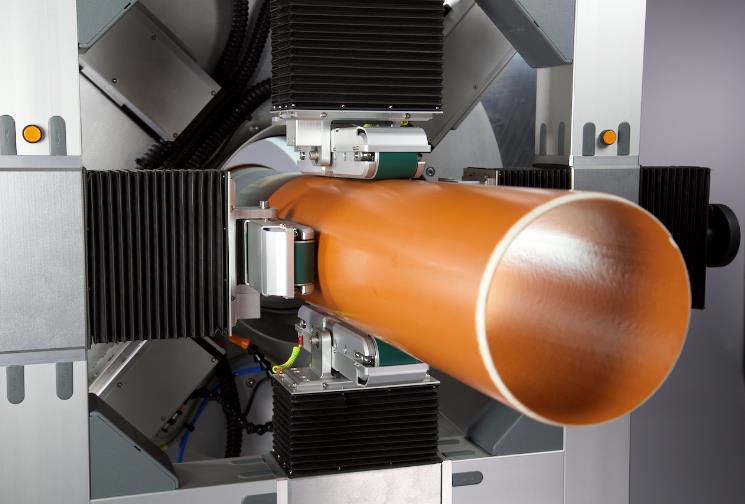
Where you meet it: wall thickness of an extruded pipe, contents of a sealed drum, blister at the end of the line.
The essentials in four points
- Passes through non-metallic materials, opaque packaging included, with no preparation. Metal stops the measurement: that is the limit of use.
- Sees inside a closed container — content, filling of a cavity, thickness of a wall or of a layer, without reopening the packaging.
- No ionising effect: no controlled area, no radiation protection.
- Reference texts: in pharma, Ph. Eur. 5.24 names terahertz; elsewhere, no text: the method is validated against your reference method.
How the measurement works
A short pulse crosses the object and its echo is recorded in time. The TERAHERTZ photon sets in motion the interactions between molecules rather than the bonds: hence the material information, and the absence of any ionising effect.
Where the instrument sits
Typical applications
Internal structure
Filling of a cavity, the tablet present or missing, an internal defect, without opening the blister.
Layer thickness
Thickness and its dispersion, including across a stack of several layers.
Raw material identity
Identification through a bag or a sealed drum, container closed.
Application examples
Checks through the packaging: content, filling, integrity, without opening.
These applications describe a claimed domain, not qualified methods: the panel “What is demonstrated” separates the two.
Identity card of the technique
| Criterion | TERAHERTZ |
|---|---|
| What the measurement sees | The band between microwaves and far infrared. Non-metallic materials are largely transparent there: the measurement is made through closed packaging. |
| Selectivity | Fair on pure substances — on our own trials, a principal component analysis separated seven of them. But the lines of solids are broadened: two close substances call for more processing. |
| What interferes | Water and polar liquids absorb strongly; metal reflects entirely. Through packaging, a strong spectral distortion, which the manufacturer acknowledges itself. |
| Sample presentation | Through closed packaging, without opening or sampling. Each packaging variant is a separate case. |
| What the model requires | A model to identify or classify. Nothing for a packaging inspection: an empty blister pocket or a broken tablet are geometric criteria. |
| Reference texts | In pharma: no chapter is devoted to it in its own right, but Ph. Eur. 5.24, Chemical imaging, names far-infrared (FIR)/terahertz and time-domain terahertz spectroscopy among the three-dimensional imaging methods it applies to; for a measurement outside imaging, validation in the sense of ICH Q2(R2). Outside pharma: no text is devoted to it: the method is validated on its own terms, against your laboratory’s reference method. |
Where TERAHERTZ sits in the spectrum
What is demonstrated, and under which conditions
A first marker, from an independent source. The USP technical guide Powder characterization for continuous manufacturing applications (© 2025) names TERAHERTZ spectroscopy among the PAT tools used for in-line measurement of dry granulation ribbon attributes — thickness, width, porosity, density and its uniformity — alongside infrared thermography, near-infrared chemical imaging and microwave resonance. That is a mention, not a qualification: it places the technique in the landscape USP describes, and it replaces no trial on your product.
Two results are documented with figures. Each was obtained on a stated product, so each transfers to another product through a trial. The conditions of the demonstration are the part worth reading, and writing them down is our trade: a result transferred too fast is paid for on your schedule.
Two results, and what each one covers
| What was shown | The figure | What it covers |
|---|---|---|
| Inspection of a blister pack through its closed packaging | Broken tablet and missing tablet clearly identified, at 100 GHz as at 300 GHz | A defect of shape, through the pack. Content and identity are a separate question |
| Identification of a substance inside a sealed envelope, through eight and then sixteen sheets of paper | At normal incidence the multiple reflections cover the substance’s lines; at Brewster’s angle the false positives drop by a factor of 14 and 10, at a correlation threshold of 0.2 | That packaging can be crossed, and under which geometric condition. Paper is not a blister: the transfer is shown by a trial |
The first result was provided to us by Fraunhofer ITWM and is published with its written permission — by courtesy of Fraunhofer ITWM. The second is open access: Molter et al., Applied Sciences 2021, 11, 950.
Against X-rays, the argument is operability
At 1 THz, a photon carries 4 meV, against a thermal agitation of 26 meV at 300 K. The radiation therefore sits well below what would ionise or dissociate a molecule. No ionising or dissociating effect, and no particular radiation protection measure.
In practice: no controlled area, no dosimetry, no periodic regulatory source check. It is an operability advantage, and it is real. TERAHERTZ equipment installs where an X-ray generator would call for a file and a room. That is what it means, and it is worth exactly that.
TERAHERTZ passes through non-metals, and reflects off metal
This point is often read the other way round. Metal detection sits outside its domain, and the manufacturer claims it nowhere. The physics runs the other way: it is non-metallic materials that are transparent to TERAHERTZ, and the whole interest of the method comes from there.
So where your need is finding dense foreign bodies in a packed product, X-ray inspection stays the answer, and the radiation-protection advantage belongs to a different question.
For tablet coating, OCT is the documented route
The multilayer thickness measurement exists and it is validated — in another sector, on another coating. Transferred to the coating of a tablet it stays to be demonstrated, so we point to the documented route instead. The technology that answers that problem is optical coherence tomography, which measures layer thickness and its dispersion with no multivariate model to calibrate. See coating thickness.
What is stated as possible in principle
Two applications are announced as possible in principle. We keep the manufacturer’s wording because it is honest.
- Moisture content. Determining moisture in a powder is announced as achievable; the range, the prediction error and the coefficient of determination are established by trial. The laboratory literature does publish them — on wood, paper and food products. What is missing is therefore not the proof that water shows, but the transfer to your powder and your configuration. That is a feasibility rather than a method. For routine following, better documented routes exist, described on the page moisture content.
- Polymorphism and the amorphous / crystalline distinction. Same status on the manufacturer’s side: the phrase in principle returns insistently, with no performance figure. The sensitivity of TERAHERTZ to the crystal lattice is physically founded, and figures of merit are published in the laboratory — quantification of polymorphism and of degree of crystallinity. What a project needs next are those figures on your real case, and in line.
Both subjects deserve a trial where they matter to you. They deserve a trial, and that is the line a proof of concept draws: knowing whether the signal separates, before any commitment.
The bounds the manufacturer states itself
We publish them as they stand: documentation that states its own bounds is documentation you can rely on.
Polar liquids are the demanding case
Water first among them. A strongly aqueous medium absorbs the radiation, which shortens what the measurement reaches beyond it.
In the gas phase, polar molecules respond
A molecule with a permanent dipole moment carries a signature. So the gas analysis perimeter is narrow, and verified molecule by molecule.
The lines of solids are broadened
Signatures are wider and less separated than elsewhere. Separating two close substances therefore asks more of the processing.
Measuring through the pack moves work to the data preparation
This is the most structuring bound, and it is acknowledged. Through a pack there is strong spectral distortion, from absorption by water and from scattering. The signal that returns is not the signal of the bare product. The manufacturer adds that careful data preparation is essential for reliable identification.
So the promise of measuring without opening holds, and it moves part of the work to signal pre-processing and model building. That is chemometrics work, to be budgeted as such. See what calibration burden your measurement carries.
Four figures to request
They depend on the configuration retained, which is why they sit outside the public documentation. They are asked for, in writing, before deciding.
- The lateral resolution: the smallest detail separable in the plane. It decides whether a cavity or a point defect is seen.
- The depth resolution: the ability to separate two close interfaces, and so what a multilayer measurement really resolves.
- The scanning speed: the time to cover a given area. That, rather than the acquisition rate at one point, says whether the measurement follows your pace.
- The maximum measurable thickness: how far the signal stays usable in your matrix, which is a different question from a reference material.
What is worth preparing on your side
- Real examples of your packaging, with its variants: film thicknesses, printing, labels, outer packs. The distortion follows the pack, so each variant is a case of its own.
- Samples carrying the defect to detect, in sufficient number. A defect seen once is a start, and a detection performance is built on many.
- A written definition of the decision expected: sorting, alerting, or characterising in development alone. A check that decides calls for analytical procedure validation, where a characterisation trial does not.
Frequently asked questions
Can a raw material really be identified with the drum closed?
Through a non-metallic pack, the signal passes. Between the signal passing and the identification being reliable sit the spectral distortion and the data preparation work the manufacturer itself calls essential. So it is a subject for a trial, on your packs and your materials. The page raw material identity compares this route with the others.
Can TERAHERTZ replace a foreign body detector?
Metal reflects the radiation entirely, so a metal part shows up through the disturbance it creates in the image, which makes an indirect detection conceivable. It is not a measurement, and the manufacturer claims it nowhere. Its advantage over X-rays is the absence of radiation protection, which belongs to the operating conditions rather than to the detection capability.
Why do you not propose TERAHERTZ for measuring a coating?
Not because the evidence is missing: terahertz pulsed imaging has been measuring tablet coatings since 2007, validated against microscopy of cross-sections and then against X-ray microtomography, and an in-line sensor did it in real time in a coating pan as early as 2011. It is a question of thickness range and scope. The reference literature gives OCT the coatings of 10 to 60 µm and terahertz those of 40 µm and above: the two are complementary rather than competing. We deploy OCT on coating because that is the thickness range of the coatings we are asked about, and terahertz where it stands alone — through closed packaging. If your coating is thick, enteric or heavily pigmented, the split is worth reopening.
Lin, Zhang, Markl, Zeitler, Shen, Applied Sciences 2018, 8(12), 2700, doi:10.3390/app8122700, open access.
Is a chemometric model needed?
For identification or classification, yes. The usual route is comparison with a reference spectral database, followed by a multivariate classification — PCA and SIMCA are the methods described for that use by Ph. Eur. 5.21 and USP ⟨1039⟩. On our own trials, a principal component analysis separated seven substances; the data belongs to the client and we publish none of its performance figures.
That route has a limit, and its authors state it themselves: “In case of a non-restricted identification problem, where also unknown spectra have to be considered, this PCA might not be suited best.” — Molter et al., Applied Sciences 2021, 11(3), 950, doi:10.3390/app11030950, open access. The method recognises what is already in the reference database; it is not built to flag the unknown. That is precisely what matters when identifying through a pack, and it is a question to carry into the trial protocol. For packaging inspection, an empty cavity or a broken tablet, the criterion is geometric and much simpler. The two uses carry different costs and different upkeep.
Does a result obtained on pure substances hold for our formulation?
No, and that is the question to raise early. On a formulation, with excipients common to several products and through a pack, the task is of another order. A demonstration on pure substances says the physics allows it. It says nothing about your matrix.
And where another route serves better?
Then we say so, and we say which route it is. A strongly aqueous matrix, a metallised pack, a need for an absolute content with no reference campaign available: three cases where the answer is another route. RAMAN and MIR often take up the composition question, and the scoping says which. The page the conditions a non-destructive measurement holds on lists these situations.
The instruments we implement
Fraunhofer ITWM, TERAHERTZ systems. Laboratory configurations for characterisation, and systems integrable in-line for checking in production.
Tell us what you want to see with the container closed. You will hear whether TERAHERTZ sees it.
Forty-five minutes is enough: whether your pack passes the signal, whether the quantity you are after belongs to what is demonstrated or to what is stated in principle, and what the alternative would be.