
An operation run to a fixed duration carries a safety margin. That margin is paid on every batch, including those that had no use for it.
- A drying set at four hours, because the slowest batch took three hours forty. On the others, the heat goes into the room.
- A blend stopped at twenty minutes, because that is the instruction. Whether it was homogeneous at twelve is worth knowing.
- A reaction followed by sampling every half hour. The decision to stop arrives half an hour later, at best.
Detecting the endpoint means stopping at the right moment.
What it changes, in practice
The gain from a measured endpoint is calculated on the spread of durations rather than on the cost of the analysis.
An operation set on its worst case carries a margin equal to the gap between the slowest batch and the median batch. Measuring the endpoint returns that margin on the batches that had no use for it, which is to say on at least half of them. Cycle time shortens, and utilities consumption follows: steam, compressed air, energy.
The calculation is made from your own data before any investment: real durations, hourly cost of the equipment, number of batches per year. It is the first deliverable of a scoping phase, and where it concludes that the investment waits for another opportunity, that is a result too.
What is actually measured
An endpoint is never measured directly. What is measured is a quantity that stops changing, and the question is which one. Three families of criteria, and they do not cost the same.
A content that reaches a target
Residual moisture content, content of one constituent. The most eloquent criterion and the most demanding, since an absolute value calls for a calibrated model and reference samples covering the real variability.
A dispersion that converges
The spread between measurement points falls until it settles. The natural criterion for blend homogeneity and for coating uniformity. It bears on a variability rather than on a value.
A signal that stabilises
The quantity followed stops moving beyond the measurement noise. End of reaction, end of dissolution, equilibrium.
The second and third families ask for no calibrated chemometric model, and that changes the economics of the project: no design of experiments, no reference sample campaign, no model to keep alive. The question moves from what the value is to whether the signal is still moving.
The classical methods here are the moving block standard deviation and the comparison of variances between successive blocks, configured at instrument qualification rather than on a calibration set; their threshold is determined on the product. What calibration burden your measurement carries.
Which technology for which case
Two columns decide: the calibration burden and the known condition. The others are negotiable.
| Technology | What it follows | Suitable matrices | Calibration burden | Installation | Known condition |
|---|---|---|---|---|---|
| NIR spectroscopy | Moisture content, homogeneity, content of a constituent | Powders, granules, tablets, divided solids | Full for a content. None where the criterion is a stabilisation | Probe in contact or through a window | Analyses a few milligrams per measurement. Penetration depth varies with the material |
| NIR-HPTLS | Composition in a liquid medium | Bioproduction media only | None, pure component spectra | Fixed optical path | Calls for the composition to be known and declared |
| RAMAN spectroscopy | Reaction progress, polymorphism | Liquids, suspensions, solids | Full, or light by following one characteristic band | Immersed or contact-free probe | Fluorescence of the matrix. Local heating possible |
| MIR spectroscopy | Supersaturation, composition of the liquid phase | Liquids, loaded ones included | None, pure-component spectra | Cell or ATR | Short optical path. Water absorbs strongly |
| Electrical tomography ECT and ERT | Phase distribution, end of homogenisation | Vessels, pipes, opaque volumes | None | Wall or belt electrodes | Returns a distribution with no model. A content calls for a soft sensor to calibrate |
| Optical coherence tomography OCT | Layer thickness and its dispersion | Coatings | None | Contact-free, in the drum or in-line | Probe to sample distance held to within a few tens of microns |
Where the measurement sits in the process
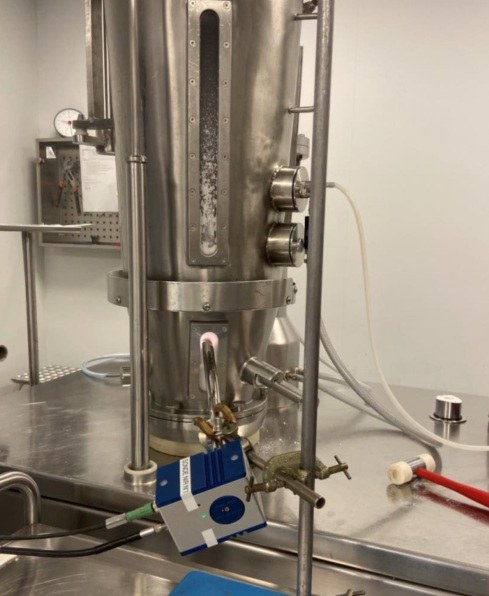
| Mode | What it is | For an endpoint |
|---|---|---|
| In-line | The sensor measures in the stream: nothing is removed. In contact, behind a window, or with no contact above the product | The reference position. No latency, immediate decision |
| On-line | A fraction of the material is diverted to a measurement cell, then most often returned to the process | Suits a process whose transit time stays short against its dynamics |
| At-line | A sample removed from the process and measured beside the line | Useful in development, and the pace of decision is what it turns on |
| Off-line | Sent to the laboratory | Serves as the reference for building the criterion rather than for triggering it |
An at-line measurement returning its result in ten minutes belongs to a different time scale from a forty-minute drying. The first question is the pace of decision, and the technology follows from the answer.
What is worth preparing on your side
Five elements condition success.
- The history of real durations of the operation, batch by batch, over several months: costing the ROI before anything is installed.
- Reference measurements at several moments of the operation, not only at the end: an endpoint criterion is built on a trajectory.
- Mechanical access at the right place, process connection, window or probe port: often the real limiting factor, to be handled with the engineering projects team.
- Line time on representative batches, difficult batches included: they are the ones that justify the project.
- A process contact who knows the drifts and the unwritten rules: operators know when a batch feels wrong.
Conditions for success
No technology suits everything. Here is what needs to have been checked before committing to anything.
A stabilised signal and a conforming product are two statements
The most often forgotten limit. A blend can reach a homogeneity plateau at the wrong content, because a charge was forgotten or because a raw material drifted. Stabilisation says the process has stopped changing. It does not say it ended up where it should. An endpoint criterion does not replace a conformity test, it complements it.
The endpoint is detected where the sensor looks
A spectroscopic measurement analyses only a few milligrams of material at a time. If the sensor sees an unrepresentative portion of the flow, the bottom of a vessel for instance, it will faithfully detect the endpoint of that portion. No instrument performance corrects a position defect.
The rate bounds the time scale that can be steered
An acquisition time of three seconds cannot follow an event lasting one. Matching measurement time and probed volume to the speed of the process is what makes the event visible. Averaging ten spectra from the same point reduces instrument noise, never the uncertainty on the batch: to gain representativeness, you have to measure several portions.
Three cases where another route serves better
- A product too heterogeneous at the scale of the probed volume.
- A fluorescent matrix in RAMAN.
- A very aqueous medium in MIR.
Saying so during the feasibility study is what keeps the deployment on solid ground. What makes a measurement hold in routine.
Beyond the endpoint: the process signature
Classical analysis gives snapshots. Process measurement gives the film. The endpoint is where that distinction becomes concrete, and where it can go one step further.
The laboratory takes a photograph at the end
One sample, one analysis, one verdict on conformity. By the time the result arrives the batch is made, so the reading is an observation rather than a lever.
The endpoint takes the photograph at the right moment
Duration adapts to the material instead of being set by the slowest batch. That is a real gain, and it is still one photograph, taken once.
The process signature is the film
The way moisture content comes down, the way a content converges, the way a signal settles. That curve repeats from batch to batch when the process is in command, and it becomes the object of the control.
The consequence is economic before it is analytical. A departure shows during the operation, often well before the end, and its shape often says what it is. A batch that moves away at mid-course can sometimes be brought back, which is a decision the same result at the end no longer offers.
It is also what separates a Quality by Design approach from a final quality control. The laboratory verifies a result. The signature watches a behaviour.
And it is what makes continuous manufacturing steerable
On a continuous line there is no end of operation to detect: the batch is defined there by a run time or a quantity (ICH Q13). Material enters and leaves without interruption, and what remains to watch is the state of the process itself, which is to say its signature. With it, continuous manufacturing becomes something you can drive.
Detecting an endpoint is the first step and recognising a signature the second. Comparing trajectories with one another calls for no absolute value, so the calibration burden is lighter than it is usually taken to be.
From OOS to OOT: seeing the drift before the failure
A compliant result is not always a reassuring one.
- This batch is within specification. But the previous five were already trending down. Who noticed?
- This assay passes, yet it is lower than the process usually delivers. Should it be a concern?
- How many investigations this year could have started three batches earlier?
Three notions answer these questions.
OOS, out of specification
The result falls outside the acceptance criteria. It triggers a formal investigation and a batch decision. The laboratory rules on compliance.
OOT, out of trend
The result remains compliant, but the series is drifting away from its history. The failure is not there yet: it is approaching.
OOE, out of expectation
The result is compliant but departs from what process knowledge predicted. The FDA OOS guidance makes the point: a low assay, even within specification, should raise a question.
In-process measurement moves detection upstream. Each batch follows a trajectory, which is compared with its reference signature. The drift shows on the curve during the operation, while there is still time to act. Comparing trajectories does not always require a calibrated model.
The vocabulary comes from pharma, but the question is universal. In chemicals, cosmetics or food, a failure avoided always costs less than a failure investigated.
Frequently asked questions
Is an out-of-limit result from an in-process measurement an OOS?
Not automatically. The FDA OOS guidance addresses laboratory testing. It states that it does not address PAT approaches, whose routine in-process use may involve other considerations. It also leaves out in-process tests performed solely to adjust equipment in real time and prevent process drift.
That does not remove the need to investigate. An unexplained discrepancy is still a discrepancy. But the response is not improvised on the day the alarm goes off: it is written in advance into the control strategy. That document sets what an out-of-limit value triggers, what a sample outside the model’s domain triggers, and the fallback when the measurement is unavailable.
It is one of the first topics of a scoping phase.
Is a chemometric model needed to detect an endpoint?
Not always. If the criterion is a content, such as “dry down to 2 % moisture”, then yes. An absolute value is needed, and therefore a calibrated model.
If, on the other hand, the criterion is a stabilisation or a convergence, such as “blend until the dispersion stops decreasing”, then no. You follow the evolution of a signal, not its absolute value. This second route avoids the reference sample campaign and the upkeep of a model over time. It simply does not answer the same question.
How much cycle time can we hope to gain?
It depends on the current safety margin, and therefore on the dispersion of real durations. An operation where all batches behave the same way has nothing to gain. An operation whose durations vary by 30 % between the fastest and the slowest batch has a lot. The calculation is made on your history, before any investment.
Can a batch be released on an endpoint criterion?
No. An endpoint criterion steers an operation, it does not replace a conformity test.
It can, however, be integrated into a documented control strategy, up to contributing to real-time release. It is then a full analytical validation project, not an automatic consequence of installing a sensor.
What happens if the raw material changes?
That is the real test. A stabilisation criterion holds up rather well to a change of supplier, because it does not depend on an absolute calibration.
A content model, on the other hand, can leave its validity domain and give a wrong value without signalling it. Hence the need for residual monitoring and a mechanism for detecting out-of-domain samples.
Does the measurement hold up in a production environment?
Beyond laboratory precision, ask for the ingress protection rating, the temperature range, the behaviour under vibration, and a qualification protocol in flow. Qualification at rest describes the instrument; qualification in flow describes the measurement in operation, and it is built on your line.
Can it be installed on existing equipment, without modifying it?
Often yes, and it is the first point to work up: a free process connection, an existing window or probe port radically change the cost of the project. Conversely, drilling into qualified equipment entails a requalification. It is costed at scoping, not along the way.
How long between the first measurement and a usable criterion?
First, knowing whether the signal is there: the answer comes quickly, and it is plain. Then building a robust criterion on representative batches. The real variability has to have been seen, which sometimes means waiting for a difficult batch: the production calendar sets the pace. A feasibility concluded on a single batch proves nothing about routine.
And if the answer points elsewhere?
Then it is better to know it from a feasibility trial than after an installation. A documented conclusion is a deliverable: how the signal behaves, and what the alternative would be.
Describe the operation. You will know whether an endpoint is measurable, and which one.
Forty-five minutes is enough to know whether a non-destructive technology answers the question, which one is worth a trial, and what the gain would represent on your durations. You will leave with all three.