
Water is the strongest absorber in the near infrared. That is what makes its signal easy to obtain, and its value worth establishing with care.
“Is the drying finished? Is the water spread the same way through the whole batch? How much longer before I reach my specification?” These three questions arise during drying, and it is during drying that their answer is useful. The two reference methods — loss on drying and Karl Fischer titration — give the value that counts, and it is the value on which the model will be built and then verified.
Which of the two you build against has to be settled first: the two methods measure two different waters. Karl Fischer titrates all the water, including water that would never leave in an oven. Loss on drying weighs everything that evaporates under the chosen conditions: water, residual solvents, volatile degradation products. A model calibrated against one predicts that one. It is the first question to settle on a moisture project.
In short
NIR measures surface and near-subsurface water in powders, granules and tablets, in contact or contact-free above the flow, with a model calibrated on your samples. In transmission, it sees water through the whole thickness, at constant geometry.
Depending on your sector: end of drying of a pharma granule; grain, forage and silage in agrifood; biomass and feedstock in anaerobic digestion; powders, sticks and extracts in cosmetics; residual solvent in chemicals.
What is actually measured
A spectroscopic measurement does not measure “moisture”. It measures the absorption of the O–H bonds present in the volume the sensor illuminates, at the instant it illuminates it. Three gaps separate that quantity from the one the laboratory returns.
Free water and bound water do not give the same signal
The water bands — first overtone of the O–H stretch around 1400-1450 nm, stretch and bend combination around 1900-1940 nm — shift and broaden with the hydrogen-bonding state, the least bound water shifting the band towards longer wavelengths. The same total content distributed differently between surface water, adsorbed water and water of crystallisation does not produce the same spectrum. It is a richness (you can follow the state of the water, not only its quantity) and it is a limit when the model has seen only one state.
The sensor sees the surface, the laboratory sees the volume
A diffuse reflectance measurement probes a few milligrams of material, over a depth that is not a constant. The sample sent to the laboratory weighs several grams. The two values can differ without either being wrong.
The reference defines the quantity
The model learns to reproduce a laboratory method, with its exact conditions: temperature, duration, stopping criterion. Changing those conditions during the project means changing the quantity measured. The reference method must be frozen and written down before the first acquisition.
Water activity is not water content
It is the direct consequence of the above, and it concerns two sectors. Water activity — the ratio between the water vapour pressure of the product and that of pure water at the same temperature — decides microbiological stability, where total content does not. Two products at the same content can have two very different activities depending on how the water is bound in them.
And that is precisely what the spectrum sees: the water bands shift with the hydrogen-bonding state. Near infrared is therefore, by construction, closer to water activity than it is to total content. In pharmacy, two USP chapters deal with it, and their numbering says it all: the informational <1112> has covered the application of water activity to non-sterile products since 2006, and <922>, official since May 2021, carries the enforceable method that was missing. In agri-food, it is a stability criterion retained in food safety plans. The hygrometer — dew point or capacitive — remains the authoritative method.
The threshold that governs is known and it is low: below 0.60, no micro-organism grows. Moulds need about 0.70, Gram-positive bacteria 0.86, Gram-negative 0.91. Between 0.40 and 0.70, it is no longer the microbiology that decides but the chemical degradation of the active ingredient, whose rate follows water activity.
And a confusion to set aside, because it circulates. Water activity is not a fraction of “free water”. An activity of 0.50 does not mean that half the water is free: it says that the water in the product has half the energy that pure water would have under the same conditions. Water content is an extensive quantity, activity an intensive one; the sorption isotherm is what links the two, and it is specific to each product.
The watch-point, and it is decisive. Water activity is a property, not a concentration: it follows the logic of viscosity, where a relation is calibrated on a given matrix and that relation does not travel. Published work on honey shows it cleanly: coefficient of determination from 0.75 to 0.96 per variety, and from 0.58 to 0.78 as soon as two varieties are pooled, with an error of 0.02 to 0.05 on activity (liquid and powdered honey, handheld spectrometer 850-1700 nm, Food Analytical Methods, 2026). It is the limit to know before promising an in-line water activity.
Moisture almost always falls under a model calibrated on samples. And that is cost information, not a technical detail. A spectrum of pure water does exist. But the intensity of its bands in a real product depends on the matrix, the compaction, the particle size and the temperature. The spectrum therefore cannot be decomposed onto pure components: you have to regress on reference values, over a representative population.
The consequence is direct: a sample campaign, a design of experiments covering the real variability, and a model to maintain over time. Pure-component model or model calibrated on samples: what each costs, and when each is legitimate.
The exception: a liquid whose composition is known, finite and declarable. There, a calibration on pure-component spectra becomes possible, and the entry price changes in nature.
Which technology for which case
| Technology | What it follows | Suitable matrices | Calibration burden | Installation | Known condition |
|---|---|---|---|---|---|
| NIR spectroscopy | Surface and near sub-surface water | Powders, granules, tablets, divided solids | Full: PLS or PCR on your own samples | Probe in contact, window, or contact-free above the flow | Probes a few milligrams. Penetration depth varies with the material |
| NIR in transmission | Water through the whole thickness traversed | Tablets, grains, products of small thickness | Full | Source and detector either side of the sample | Calls for a constant geometry. Admissible thickness becomes limiting early |
| NIR-HPTLS | Water in a liquid of declared composition | Bioproduction media only | None: pure component spectra | Fixed optical path | Works from a composition that is known and exhaustively declared |
| MIR spectroscopy | Water in a solvent or an organic medium | Liquids, viscous and loaded ones included | None, or full depending on the matrix | Short path length cell | Water absorbs very strongly: an asset at trace level, saturation at high content |
| TERAHERTZ | Water in a solid, with the packaging left closed | Packed solids, checking on receipt | Established case by case | Contact-free, no radiation protection | Measuring water in a solid is documented in the laboratory — wood, paper, food products. What remains to be established is measuring it through industrial packaging, for which the manufacturer announces feasibility with no range or figure |
The calibration burden column on its own explains why two moisture projects that look alike carry different costs. It is a column a manufacturer fills in from the technology they make.
And if it is the moisture of a gas?
That is another family. Tunable diode laser absorption locks onto one water absorption line and reaches contents of the order of a ppm with very high selectivity. It applies only to gases, and it is sensitive to pressure variation and to the presence of carbon dioxide. It sits outside the nine measurement families covered here, and where your need is there, we will point you in the right direction.
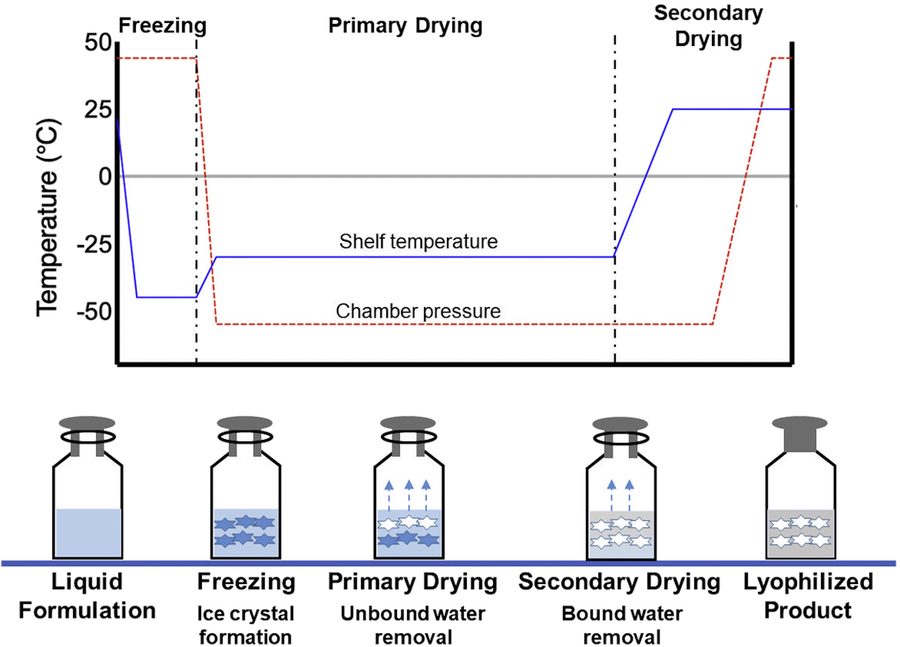
What about the cake, in its sealed vial?
Once the cycle is over, the question changes. What is the residual moisture in every vial, not just in the ones that get opened? Is the batch uniform from one shelf to the next? Can an out-of-specification vial be rejected without opening the others?
Karl Fischer titration, usually coulometric (Ph. Eur. 2.5.32), remains the value of record: the model is built on it, then checked against it. It consumes the vial it measures. NIR reads the cake through the bottom of the vial, without opening it or breaking the seal, in a few seconds. It can therefore follow every unit in-line.
Three points decide feasibility:
- A narrow range. Specifications often sit at a few percent, sometimes less. Calibration needs reference vials that deliberately span that range, and slightly beyond.
- The base of the cake. The measurement sees the layer in contact with the glass. If water is not evenly distributed through the cake’s thickness, the offset between the base and the whole cake must be known and built into the model.
- Glass and structure. Bottom thickness and curvature, cake density and porosity all change light scattering. A model holds for one formulation and one vial format.
Not to be confused: headspace moisture, measured by laser diode, is the humidity of a gas. That is the other family described above. The framework stays the one on this page: Ph. Eur. 2.2.40 and USP <1119> for the spectroscopy, ICH Q2(R2) if the measurement is to support release.
Where the measurement sits in the process
| Mode | What it means for a moisture measurement |
|---|---|
| In-line | The sensor sits in the dryer, the blender or the pipe — in contact, behind a window, or with no contact above the product. Nothing is removed, and it is the one position that allows the operation to be stopped at the right moment. Product temperature and window fouling are part of the design |
| On-line | A fraction is diverted from the stream, measured, then most often returned. Suits a drying whose transit time stays short against its dynamics |
| At-line | A sample measured beside the line, in seconds instead of forty minutes. Already a clear gain in development and in area release, and the pace of decision is what it turns on |
| Off-line | Stays essential: it is the reference that builds the model and the one that watches it afterwards |
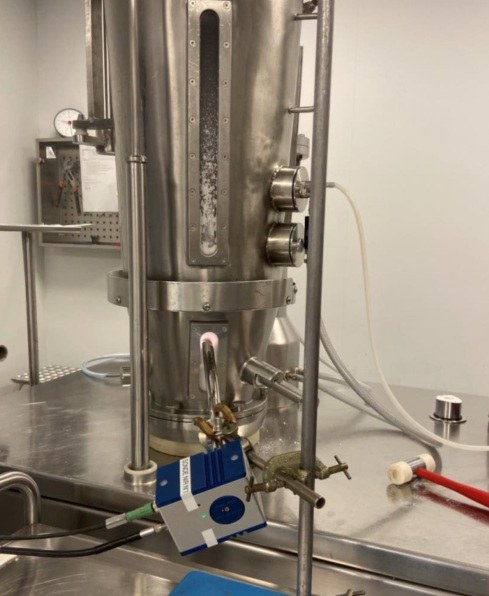
Above an open line, the window is also a food safety matter. What it asks for.
What is worth preparing on your side
Moisture projects are carried by the reference method and by the pairing of spectrum and sample, more than by the instrument.
- The reference method, written and frozen: Karl Fischer or loss on drying, and in the second case the exact temperature, duration and stopping criterion. A model is worth what its reference is worth.
- The time pairing between spectrum and sample. On a fast-moving drying, two minutes between acquisition and sampling is enough to shape a calibration, and the effect shows up in the dispersion where it is easily read as instrument noise.
- Samples covering the real range, the high contents met only in an incident included. A model that has seen the whole range is the one that recognises a batch at the edge of it.
- Raw material variability: several batches, and where possible several excipient suppliers. It is the first factor in how a moisture model ages.
- Mechanical access: nozzle, window, probe port, and the question of cleaning it. On a fluid bed, window fouling is a subject in its own right rather than an installation detail.
Conditions for success and limits
A moisture model is first of all a matrix model
It learns the relation between a spectrum and a content in a given context. A change of excipient supplier, a particle size that drifts, a different compaction can carry it outside its domain of validity, where it returns a value silently. That is why out-of-domain detection is non-negotiable: Hotelling’s T squared, Q residuals, Mahalanobis distance. Keeping a model alive.
Temperature shifts the water bands
The condition most often met in production rather than in development. A model built on samples at ambient temperature, applied to a product leaving a dryer at forty-five degrees, returns a shifted value. Two answers: include temperature in the design of experiments, or measure where it is controlled. Choosing between them is an act of design.
The surface dries before the core
During a drying a gradient builds between the surface of the particles and their interior, and a reflection measurement sees the surface first. The signal can settle while the product is still approaching equilibrium, which is why the spectral criterion is crossed with the dynamics of the operation rather than read on the plateau alone.
The measurement is set up to see the material
Condensation on the window, deposit of fines, an oily film: three classical sources of a slow drift that is easily read as a model drift. The diagnosis is straightforward once it is designed in, with a reference spectrum on a clean window compared periodically.
What it changes, in practice
The gain from in-line moisture measurement shows in three places, and it is useful to know which one concerns you before investing.
Cycle time, when drying is run at a fixed duration with a safety margin: the gain is calculated on the dispersion of real durations, not on the cost of the analysis. The reject and rework rate, when batches come out of specification and have to be re-dried or destroyed. And the laboratory effort, when moisture testing takes up a full-time position.
Sometimes the answer is also that there is nothing to gain: a drying already centred, already stable, where all batches behave the same way. In that case in-line measurement only brings documentary evidence. Which may be enough in a Quality by Design approach, but is not justified by a return on investment. The calculation is made on your history, during the scoping, before any purchase.
Frequently asked questions
Can an NIR measurement replace Karl Fischer for release?
In pharma, technically yes, as an alternative analytical procedure, and the frame exists: ICH Q2(R2) for validation, ICH Q14 for procedure development, with Ph. Eur. 2.5.12 describing the reference method being replaced. It follows from a validation project rather than from installing a sensor, since accuracy, precision, specificity, range and robustness are demonstrated and the control strategy documented. Many projects deliberately stop before that point, because steering the process without claiming release already carries most of the gain. Validating an analytical procedure. Outside pharma the frame is a different one: in cereals and animal feed, applying near infrared falls under ISO 12099, and official control under Regulation (EC) No 152/2009; in anaerobic digestion no compendial text applies — the reference is your own laboratory method, and that is what has to be frozen.
How many samples does a calibration take?
There is no magic number, and coverage is what the question is really about: the range of contents, the batches, the suppliers, the seasons where they matter. Thirty well spread samples serve better than two hundred taken the same day on the same batch. What the question really covers.
What accuracy can we expect?
The reference method sets the ceiling of what can be demonstrated. The error announced for a model, the RMSEP, brings together the model error, the laboratory method error and the sampling error. A figure quoted with its reference method, its matrix and its sampling protocol is a figure you can use.
Does near infrared replace loss on drying?
No, and the word USP uses says exactly why. Its technical guide on powder characterisation, covering wet granulation and the drying that follows it, places near infrared among the PAT techniques commonly used — and writes: “near-infrared spectroscopy for loss-on-drying prediction”.
Prediction. Loss on drying stays the reference quantity: it defines what the model predicts, it is what the model is built against, and it is what verifies the model. What near infrared brings is not another value, it is the same value during the operation rather than after it. The practical consequence is the one stated above: a model calibrated against loss on drying does not predict Karl Fischer, and the other way round. Choosing the reference is the first decision of the project, not the last.
The same passage also names Raman and 3D imaging on that operation and, on the dry granulation side, infrared thermography, TERAHERTZ spectroscopy, near-infrared chemical imaging and microwave resonance. USP Technical Guide, Powder characterization for continuous manufacturing applications, © 2025 The United States Pharmacopeial Convention, Rockville, MD — § 4.3. An informational document: it carries no requirement.
Will the model survive a change of raw material supplier?
That is the test that counts, and it is anticipated: several sources built into the calibration where they exist, and residual monitoring in production to detect entry into new territory. A moisture model that has met a second supplier is a model that has been tried.
Can we measure through a bag or a wall?
It follows entirely from the material. A thin polymer film is often traversed in NIR with a correction. An opaque or metallised packaging calls for another route. TERAHERTZ passes through more materials, metal excepted. Its sensitivity to water is strong and documented in the laboratory; its performance through packaging depends on the packaging. It is a question settled by a short trial.
Do we need a model just to know when to stop drying?
Often no. Where the criterion is that the content stops falling, a stabilisation of signal is followed rather than an absolute value, which saves the reference sample campaign and the upkeep of a model. The surface to core gradient described above is the point to watch. Detecting the endpoint.
Describe your product and your reference method. You will know what the measurement holds.
Forty-five minutes is enough to know which technology suits your matrix, what calibration burden follows, and what the measurement would take to put in place.