
“Is my reaction finished? Can I stop it now without risking over-reaction? Did the previous batch follow the same trajectory?” Three questions whose answer is useful during the reaction, rather than forty minutes after the sample was taken.
That is still how most of chemical synthesis and API synthesis is run. The chromatogram is right, and it describes a reactor that has moved on. Between two samples, the trajectory is interpolated, which is to say assumed.
The sampling itself carries its own weight. It means opening a reactor that may be under inert atmosphere, under pressure or at temperature, and handling a medium that may be toxic or flammable. And the reaction carries on inside the flask: the quench slows it, and what remains of it sits outside the analysis report.
In short
MIR follows assignable chemical functions, usually without calibration. NIR follows the overall evolution of the medium, even through a thick window; an endpoint by stabilisation needs no model. RAMAN suits aqueous media, suspensions and crystallisation. The choice depends on the matrix and the question.
What is actually measured
A probe in the medium, a spectrum every few seconds. What you get out of it depends on the question asked. And the questions do not all have the same cost.
A reagent that disappears
The band of a chemical function decreases until it stabilises. It is a frequent case, and the cheapest: following a disappearance calls for no calibration.
An intermediate that accumulates
Some syntheses go through a compound that must not be allowed to build up: unstable, hazardous, or a kinetic trap. You only see it by looking during the reaction, never afterwards.
A side reaction that starts
Degradation, over-reaction, isomerisation. It appears as a band that was not expected, at a moment that can be dated. And therefore correlated with a set point.
Two other quantities come from the same set-up and deserve a mention: the induction time, the delay before the reaction really starts, which varies from batch to batch and which the recipe duration ignores; and, in crystallisation, the moment of nucleation as well as the polymorph obtained.
The point that decides the economics of the project. Answering “is the reaction finished?” and answering “what is the exact assay at this instant?” are two different questions, and they do not cost the same.
The first is handled by following a band until it stabilises: no model to build, no sample campaign. The second calls for a full calibration, with reference values by chromatography and a representative population. What each approach costs.
Many projects ask for the second when the first was enough. It is the first subject of a scoping phase.
Which technology for which case
The three spectroscopic families are practised in this field, and the choice depends not on the announced performance but on the matrix and the question.
| Technology | What it follows | Suitable media | Calibration effort | Known limit |
|---|---|---|---|---|
| MIR spectroscopy | Chemical functions, appearance and disappearance of identified compounds | Organic liquids, viscous or loaded media | None most of the time. The bands can be assigned | Short optical path required. Water absorbs strongly |
| NIR spectroscopy | Overall evolution of the medium, endpoint by stabilisation | All media, including through a thick window and over a long fibre | None for an endpoint. Full for an assay | Broad, overlapping bands: rarely assignable to a single compound |
| RAMAN spectroscopy | Molecular identity, polymorphism, conversion in aqueous media | Aqueous media, suspensions, crystallisation | None by band tracking. Full in quantitative work | Matrix fluorescence. Heating of dark media |
The short rule: MIR when the chemistry is organic and the medium not very aqueous, RAMAN when the medium is aqueous or when polymorphism is at stake, NIR when the question is an endpoint rather than an identification, or when the installation constraint imposes a long fibre and a window.
Where the measurement sits
Probe immersed in the reactor
The most direct configuration: no latency, and the spectrum describes the real medium. It brings with it the chemical resistance of the wetted materials, the temperature, the pressure, and cleaning between batches.
Recirculation loop
The cell sits outside the reactor, on a bypass. The optical path and access to the probe are better controlled, at the price of a transit time to be quantified against the dynamics of the reaction.
In chemistry one further constraint almost always joins the others: the ATEX area classification. It is settled at the first quotation rather than afterwards, and it sometimes decides for the loop rather than for immersion. Two texts carry it — directive 2014/34/EU for equipment intended for explosive atmospheres and directive 1999/92/EC on the worker side, with the IEC 60079 series on the equipment side. Zoning belongs to the operator: the employer classifies hazardous places into zones (directive 1999/92/EC; in France, article R4227-50 of the Labour Code). The equipment is then chosen, certified for the zone set.
The texts are not the same in every sector
This page is read from two doors, and the regulatory frame differs between them. That changes what a measurement has to prove before it decides anything.
- Chemicals and polymers — no text governs reaction monitoring as such. What applies is of another order: the ATEX directives above for the installation, and ASTM E1655 for building a multivariate infrared calibration, where a content is the target. REACH and CLP govern the substances, not the measurement.
- Drug substance and pharmaceutical synthesis — reaction monitoring belongs to the development and manufacture of the drug substance: ICH Q11, and ICH Q7 for the good practices applicable to active substances. As soon as a measured value decides a step change, the method is validated under ICH Q2(R2) and developed under ICH Q14.
Pharmacopoeial chapters cover the techniques used — USP <856> for near infrared, <858> for Raman, <854> for mid infrared, <1039> for chemometrics — rather than the use made of them here. All the texts, and what each governs.
Step by step: what is looked for, and what follows it
Outside pharmaceuticals, no regulatory text governs process measurement: the ASTM E1655 and D6122 standards frame calibration and in-service validation. For the steps themselves, the most complete published reference nevertheless comes from pharmaceuticals, and it holds for any synthesis.
The USP technical guide on control strategy for drug substances in continuous manufacturing gives a table we have not found elsewhere in this form: for each step, the attribute looked for, and the techniques that follow it. The steps are the same in batch.
| Step | What is looked for | Techniques named |
|---|---|---|
| Raw materials | Identification, purity | Handheld Raman, or infrared; chromatography off-line |
| Reaction | Conversion, impurity control, kinetics | IR, Raman, UV, NMR, liquid chromatography, temperature and pressure, mass flow |
| Workup | Impurity purge, solvent composition | IR, Raman, liquid chromatography |
| Crystallisation | Particle size and shape, polymorph | FBRM, PVM, turbidity, Raman |
| Filtration and drying | Solvent or water content, agglomeration | IR, Raman |
Two useful readings. First, Raman is the only technique present at all five steps — which is why it turns up both at drum identity checking and in crystallisation. Second, chromatography keeps its place in the table: USP names it off-line on raw materials, and its table 1 classes liquid chromatography as on-line and at-line. Spectroscopic monitoring does not replace it; it changes when you know.
Four words that do not mean the same thing
Each says what becomes of the sample, and the gap between two of them often decides a budget.
- In-line — the sensor measures in the stream and nothing is removed: in contact, behind a window, or without contact.
- On-line — a fraction is diverted from the stream to a measurement cell, then most often returned to the process.
- At-line — the sample is taken out, manually or automatically, and tested aside from the running process.
- Off-line — the sample goes elsewhere, to a laboratory. The USP guide states what that means in continuous manufacturing: this route is not useful for real-time decision-making. It serves process development, and the comparison of in-line and on-line measurements with a traditional compendial method. Which is exactly what an in-line measurement project asks of it.
In pharma, this USP guide calls on-line a sensor mounted on the line without contact with the material, and keeps in-line for contact: check the convention of your own reference text.
USP Technical Guide, Control strategy for continuous manufacturing of drug substances, © 2025 The United States Pharmacopeial Convention, Rockville, MD — § 2.4, table 1 for the implementation modes and table 2 for the steps. An informational document: it carries no requirement, and says so on its own first page.
Conditions for success and limits
Window fouling is the first thing to design for
A deposit on the optics moves the signal exactly as a chemical evolution would, and the raw spectrum reads the same either way. It is handled at design: geometry, cleaning in place, a measurement quality indicator.
Temperature shifts the bands
A reaction medium rises and falls in temperature during the operation and the spectrum carries the trace of it, independently of the chemistry. A model that holds that variable learns the progress. A model that leaves it out learns the temperature.
A heterogeneous medium is several media
On a suspension or an emulsion the probe sees the phase it touches. Where the solid settles or the agitation stops, the measurement stays right and describes that phase. It is a question of position rather than of performance.
The acquisition rate sets what can be steered
One acquisition a minute belongs to a different time scale from a phenomenon lasting thirty seconds. On fast or strongly exothermic reactions, the useful rate is calculated before the instrument is chosen.
What it changes, in practice
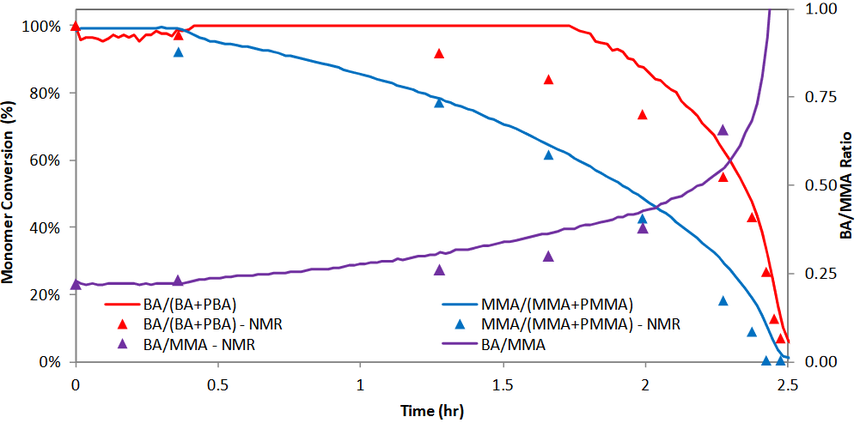
The operation ends when the chemistry does
Rather than at the end of the time set for the slowest batch. On a long synthesis, a few hours recovered per batch read directly as capacity in the workshop.
You open the reactor less often
Fewer samples means less operator exposure, fewer breaks in the inert blanket, and a result that no longer depends on the quality of the quench.
You know why a batch departed
A process signature recorded batch after batch turns a non-conformity into a diagnosis. Without it, what remains is a final result and a set of hypotheses.
Scale-up gains as much as production does. A process whose signature is known in the laboratory transposes to pilot and then to industrial scale against an objective comparison criterion, rather than against a duration adjusted by experience. That holds in API development as in fine chemicals.
Frequently asked questions
Is a calibration needed, yes or no?
To know when the reaction is finished, no: a band is followed to its stabilisation and the criterion is a convergence rather than a value. To return an assay at a given instant, yes: reference values by chromatography and a population covering the real variability. The difference between the two counts in calibration burden and in upkeep. The full reasoning.
Does it replace chromatography?
Chromatography separates and quantifies compounds at trace level, which is its own ground and stays there. What in-line measurement replaces is the process sample, the one taken to decide what to do now. Release testing stays in the laboratory.
MIR, NIR or RAMAN: how do we decide?
By the matrix first. An organic medium low in water calls for MIR, whose bands are assignable with no model. An aqueous medium calls for RAMAN, which water disturbs little. NIR comes into its own where the constraint is mechanical, a long fibre, a thick window, a reactor of difficult access, or where the question is an endpoint rather than an identification. On a real case the arbitration is made on your spectra, acquired on your product.
And on a reaction in a very concentrated or opaque medium?
The optical path becomes the subject. In MIR, an attenuated total reflection cell measures over a few microns and is indifferent to opacity. In RAMAN, a very dark medium heats under the beam, which calls for reduced power and so for a longer acquisition time. Both points are verified by a short trial.
How long before we know whether it works?
First, establishing whether the reaction has a usable spectral signature. That is the question that decides, and it is answered on your medium rather than on a model medium. Then a robust criterion on representative batches, the ones that went off course included: the production calendar sets its pace. What a feasibility study concludes, including when it points to another route.
Describe your reaction. You will know what is measurable, and what it takes.
Forty-five minutes is enough to know whether your chemistry has a usable spectral signature and which of the three families suits it. Then whether an endpoint read on a state answers your need with no model to calibrate, and what the area classification of your workshop asks of the hardware.